Elena Schmidt · 22 October 2026
Pioneer Species Succession Patterns Shape Containment Outcomes in Mobile Sediment Fields Across Expansive Dry Expanses
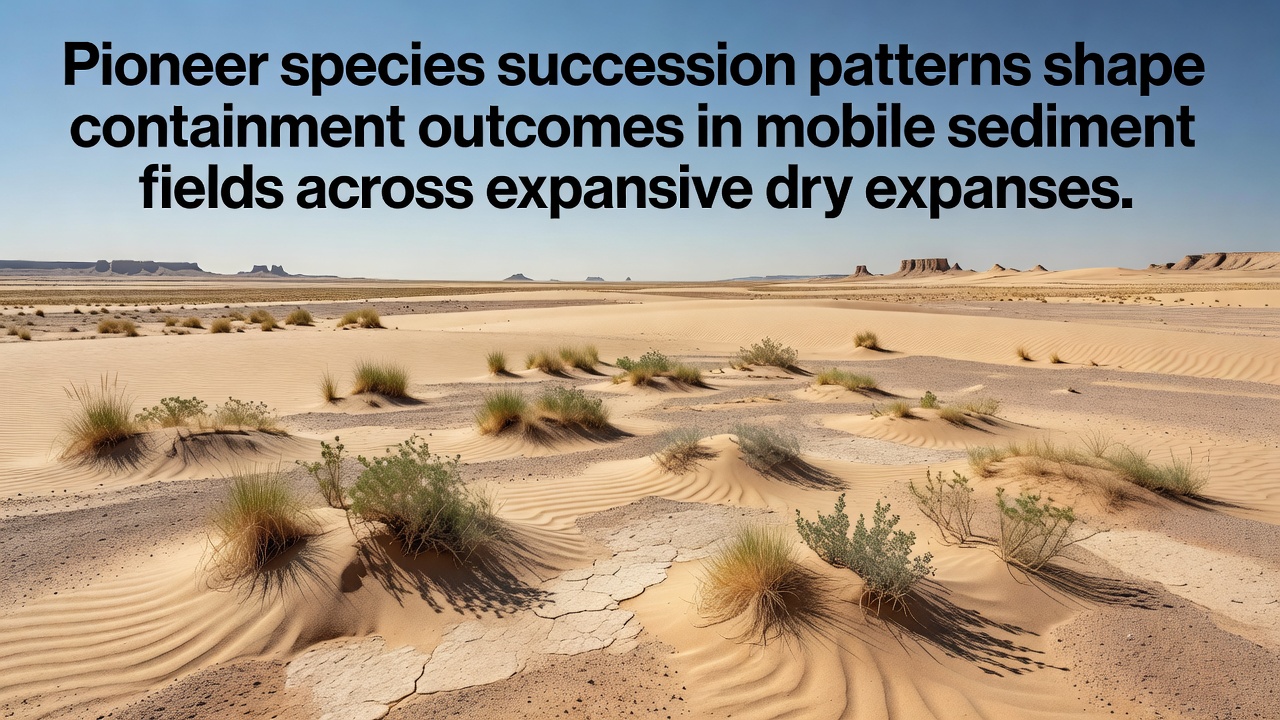
Ecological processes in expansive dry regions depend heavily on how initial colonizers interact with loose sediments, and researchers have documented these dynamics across multiple continents for decades, while patterns emerge from repeated field observations in places like the Mojave, the Simpson Desert, and the Namib. Pioneer species arrive first on bare, mobile surfaces where wind and occasional flash floods keep grains in constant motion, and their root systems plus surface cover begin to trap particles that would otherwise continue traveling.
Initial Colonization and Early Stabilization
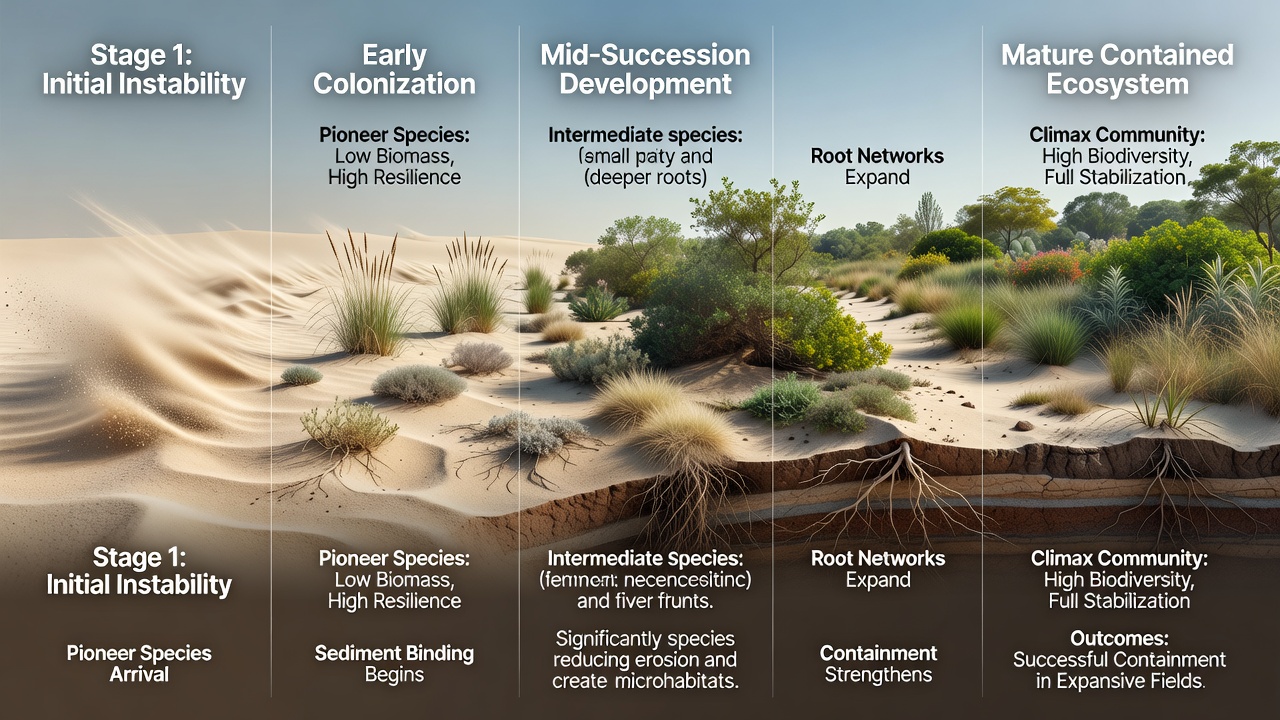
Grasses such as certain species of Spinifex in Australia and Sand verbena in North American basins often represent the earliest arrivals because they tolerate burial and exposure cycles that kill most other plants, and data collected by the United States Geological Survey shows that these species can reduce surface wind speeds by up to thirty percent within the first growing season once cover reaches fifteen percent. Observers note that nitrogen-fixing shrubs like Mesquite or Acacias follow shortly afterward because they exploit the slightly sheltered micro-sites created by the grasses, yet their deeper roots further bind subsurface layers that grasses alone cannot reach.
Succession Sequences Across Different Arid Zones
Succession does not follow a single linear path in every location, and studies compiled by CSIRO in Australia demonstrate that rainfall timing and sediment mineralogy determine whether perennial grasses give way to woody shrubs or to a mixed herbaceous layer within five to fifteen years. In regions where winter rains dominate, annual forbs may briefly dominate before perennials establish, whereas summer-dominated precipitation favors species that germinate rapidly after convective storms. Those who've monitored plots over multiple decades report that once total vegetative cover exceeds forty percent, net sediment transport drops sharply, and the surface begins to develop small hummocks that further reduce wind fetch.
Role of Species Interactions in Containment
Competition and facilitation both operate during these transitions, and researchers have recorded instances where early colonizers modify soil chemistry enough to allow later arrivals that then outcompete the pioneers. For example, certain lichen and moss crusts that develop beneath initial plant canopies increase surface cohesion, and this crust formation correlates with measurable declines in dust emission rates according to long-term monitoring networks. The process accelerates when multiple functional groups coexist because their combined canopy and root architectures create layered resistance to both wind and water erosion.
Observed Outcomes in Containment Projects
Containment results vary according to which species establish first and how quickly succession proceeds, and comparative data from restoration sites in the southwestern United States and central Australia reveal that projects relying on a narrow set of pioneer grasses achieve initial cover faster but experience higher rates of reversal during extreme wind events. In contrast, sites where natural recruitment of multiple species occurs within the first three years maintain containment even when precipitation falls below long-term averages. Figures released in October 2026 from an international arid-lands monitoring consortium indicate that areas with documented multi-stage succession retained eighty-five percent of their sediment volume over the preceding decade, whereas single-species plantings retained only sixty-two percent under similar conditions.
Seed dispersal mechanisms also influence outcomes because wind-dispersed species reach new mobile patches more reliably than those relying on animal vectors, and this difference becomes pronounced when sediment fields exceed several square kilometers. Managers therefore sometimes introduce nurse plants that create perches or shelter for seed-carrying animals, and the resulting increase in species richness correlates with more resilient containment structures over time.
Conclusion
Patterns of pioneer species establishment and subsequent succession directly determine how effectively mobile sediments remain contained within expansive dry landscapes, and continued monitoring across diverse regions continues to refine understanding of the thresholds at which transport rates decline. The evidence accumulated so far points to the importance of allowing or encouraging multi-species development rather than relying on any single colonizer, and this approach has produced measurable reductions in sediment movement wherever it has been applied consistently.